
Courtice Heritage Driving Tour
Take a trip through Courtice’s historical past and present! Explore points of interest including attractions, long-standing businesses, public art, natural features, religious buildings, heritage homes, and historical buildings of our past.
Pick up the booklet with all points of interest, write ups, and photos at the Sarah Jane Williams Museum or Courtice Library, or download the two-page driving map and list.
You can also explore the tour digitally via Google Maps, or through the write ups below!
Introduction
Welcome
Welcome to the Courtice Heritage Driving Tour! We invite you to take a leisurely drive through the community of Courtice to explore the rich history and culture of this area of Clarington. A reminder to please be respectful of private property while you enjoy the tour. Clarington Library, Museums and Archives wishes to thank our partners in the annual Celebrate Courtice History event for their assistance with the creation of this tour: Courtice Vintage History Facebook group, and the Municipality of Clarington.
Point of Interest Categories
As part of this heritage driving tour, you will find places of interest such as long-standing businesses, public art features, natural landscape sites, and historic architecture. This tour includes a colour coded map and numbers to help you select the sites you wish to see by topic.
You can also follow the map from start to finish to see all the sites we have included. Check out the downloadable map for a full list of sites with their addresses.
A Brief History of Courtice
Courtice is named after Thomas Courtice who arrived in Darlington Township in 1831. The community was first centered around Ebenezer Church (1669 Courtice Rd.) and so the growing settlement was called ‘Ebenezer’ for some time. Courtice eventually encompassed an area called Short’s Corners, named after George Short who owned a blacksmith shop where Roy Nichols’ business is located on Courtice Road today.
Short’s Corners would soon become downtown Courtice. A market run by A.F. Rundle opened across the street in 1860, and in 1874, James Courtice, brother of Thomas Courtice, opened a carpentry shop beside the market.
Courtice would eventually expand to include Prestonvale, previously known as Black’s Hill. Black’s Hill was home to the first post office in Darlington. It was named after Colonel James Black, the first postmaster. By the mid-19th century, a post office with the name ‘Courtice’ was established with rail connections becoming available on both the Canadian Pacific and Grand Trunk lines.
ATTRACTIONS & LONG-STANDING BUSINESSES
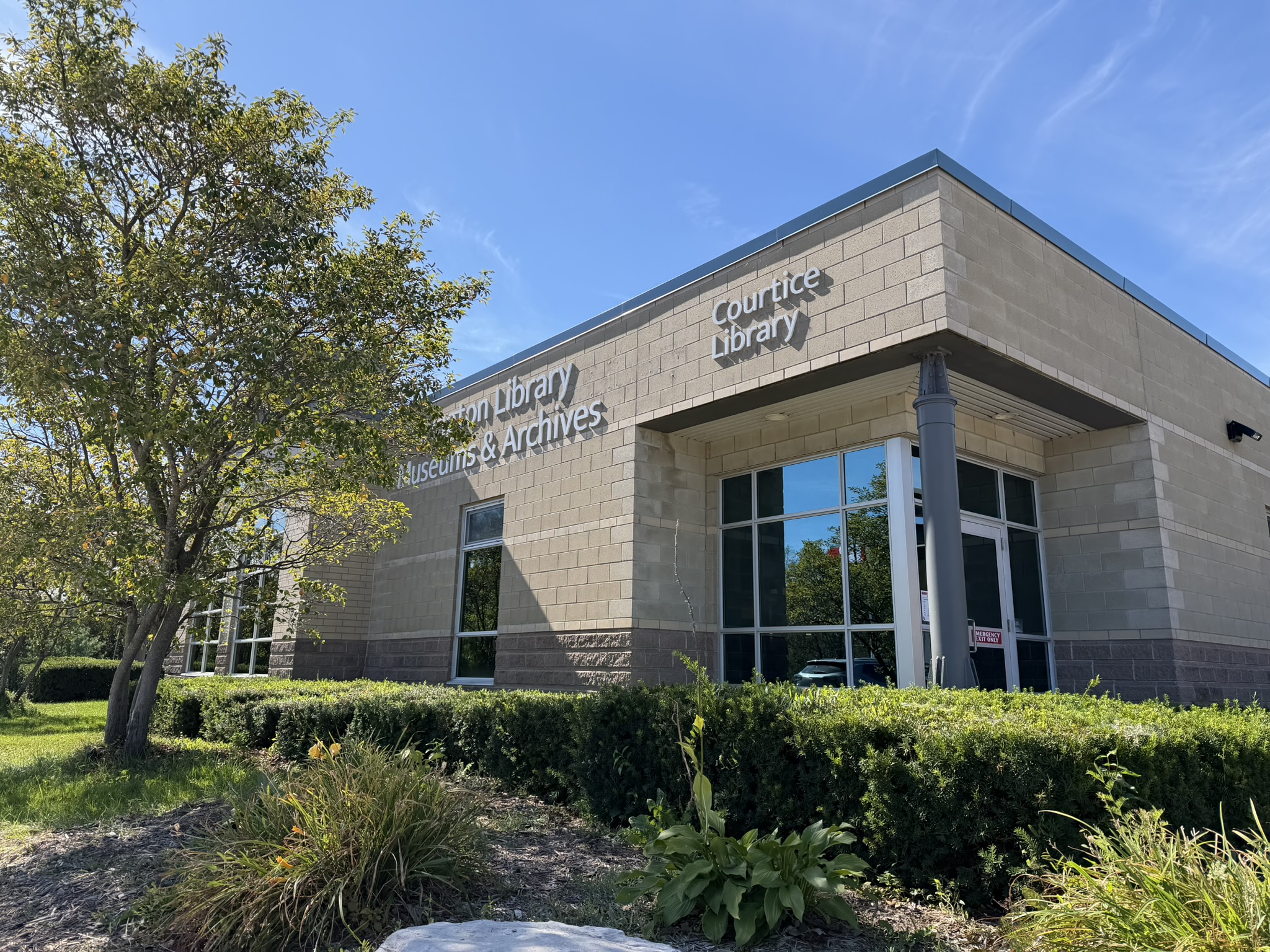
1. Clarington Library, Museums & Archives, Courtice Library
2950 Courtice Rd, Courtice
CLMA inspires curiosity and is a destination where our community can relax, connect, learn, and thrive! Explore the Courtice Library, including local heritage displays and the Maker’s Space, with 3D printing, sublimation printing, and sewing machines. Discover the Literacy Ship and colourful children’s area, extensive collections, and wealth of programming for all ages.


3. Roy Nichols Motors
2728 Courtice Rd, Courtice
Roy Nichols was born in Courtice, and he started his business in 1922. At that time, it consisted of a small garage for automobile repairs and a gas pump. By 1928, Nichols became a dealer of Willys-Overland, Willys Knight and Whippet cars. By 1933, this changed to General Motors. Customers could browse Nichols’ selection of cars in showrooms starting as early as the 1930s.
Roy Nichols Motors is still a family-owned store today that has been proudly serving Courtice, Ontario, and the surrounding communities since 1922.
More information:
- Roy Nichols Motors:
https://www.roynicholsmotors.com/
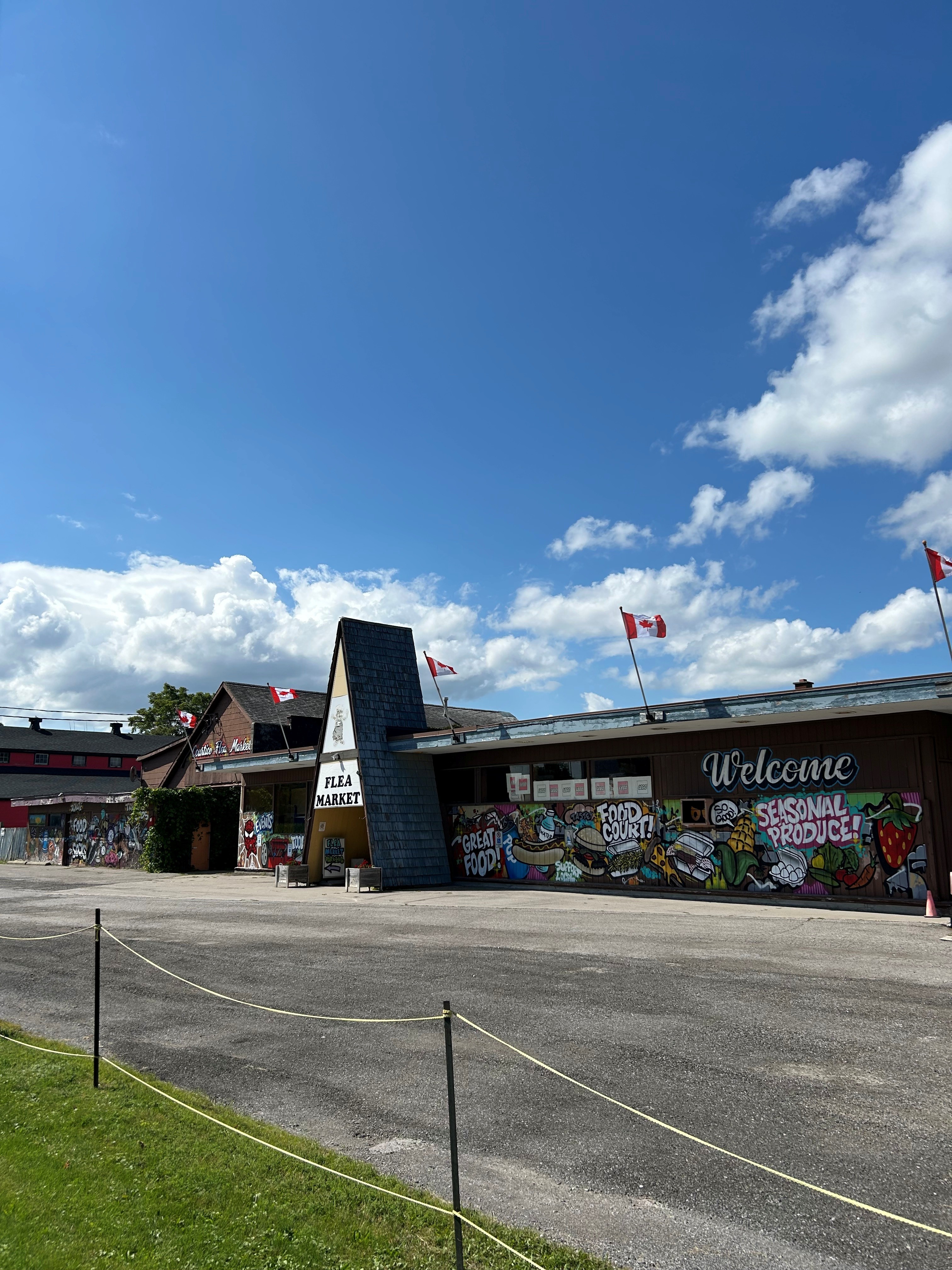
19. Courtice Flea Market
1696 Bloor St, Courtice
Courtice Flea Market began in 1992 on the site of what was formerly a lumber yard. Once operating as Henry Build-All Lumber, it was formerly Oshawa Wood Products for over 40 years: a name adopted again post-fire in May 1960. This site required a rezoning to operate as the Flea Market and Auction Barn.
The Flea Market property extends 12 acres, and the market is open every Sunday between May and November. It offers a variety of vendors and food, as well as a seasonal farmers market and the Art Shack Artisan Market.
Did You Know? The cute raccoon on the sign has the nickname “Cousin Courtice.” This mascot used to give away free balloons to kids who visited the market.
More information:
- Courtice Flea Market:
https://www.facebook.com/courticefleamarket/
PUBLIC ART & NATURAL FEATURES
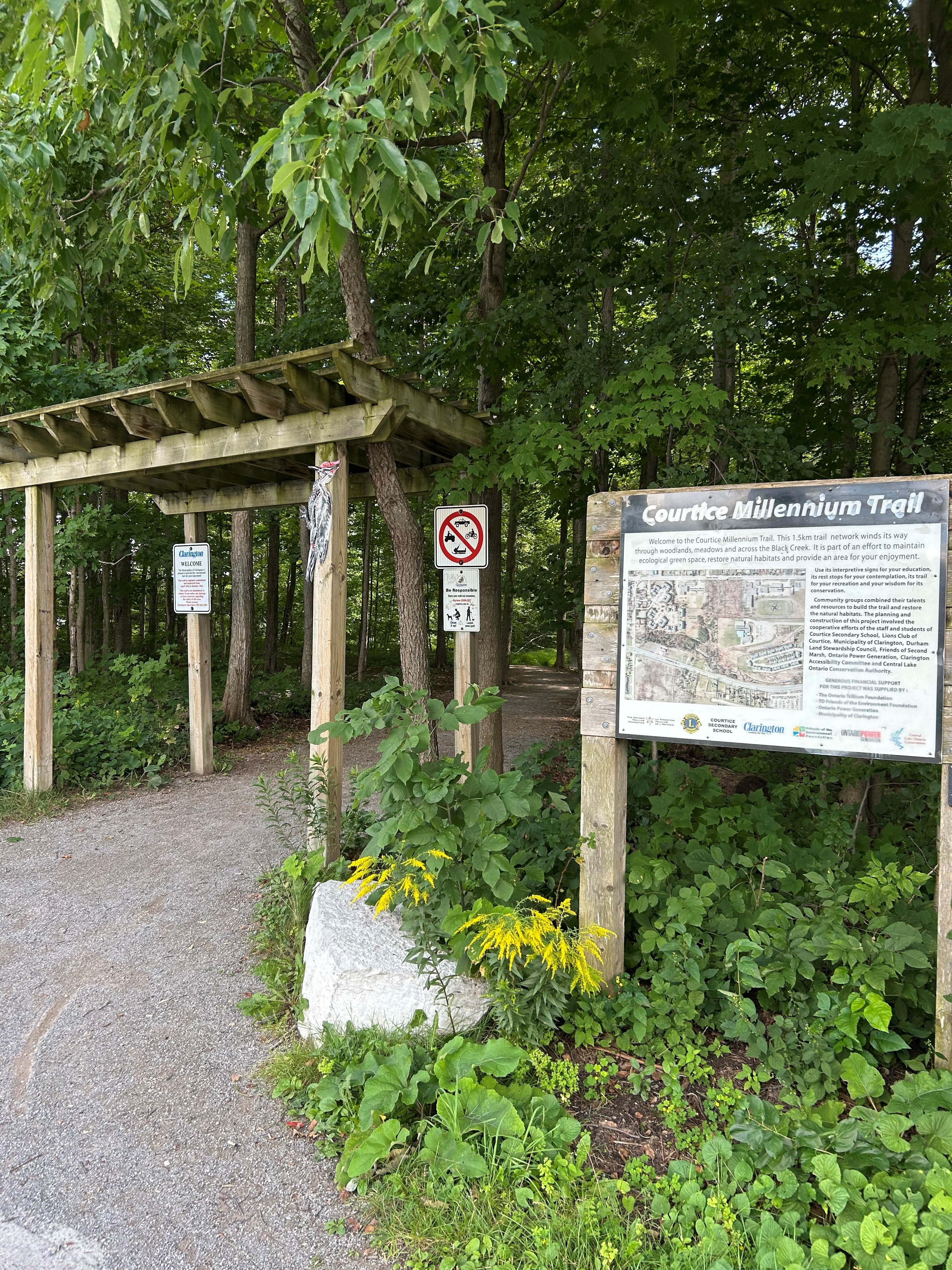
2. Millennium Trail
1701 Nash Rd, Courtice (west of Courtice Community Centre)
This trail connects from the west side of the Courtice Community Centre to a western entrance near Highway 2 at Tooley’s Mill. The trail runs 1.5 KM, and it was dedicated in 2002, although expansion of the trail continued for the next decade (completed May 28, 2010).
Thanks to the efforts of several local community groups, including the Courtice Secondary School Students, Lions Club of Courtice, The Municipality of Clarington, Durham Land Stewardship Council, Friends of Second Marsh, Ontario Power Generation, Clarington Accessibility Committee, and Central Lake Ontario Conservation Authority, many residents enjoy this trail today.
Did You Know? More than 400 tonnes of limestone were required to complete the trail.
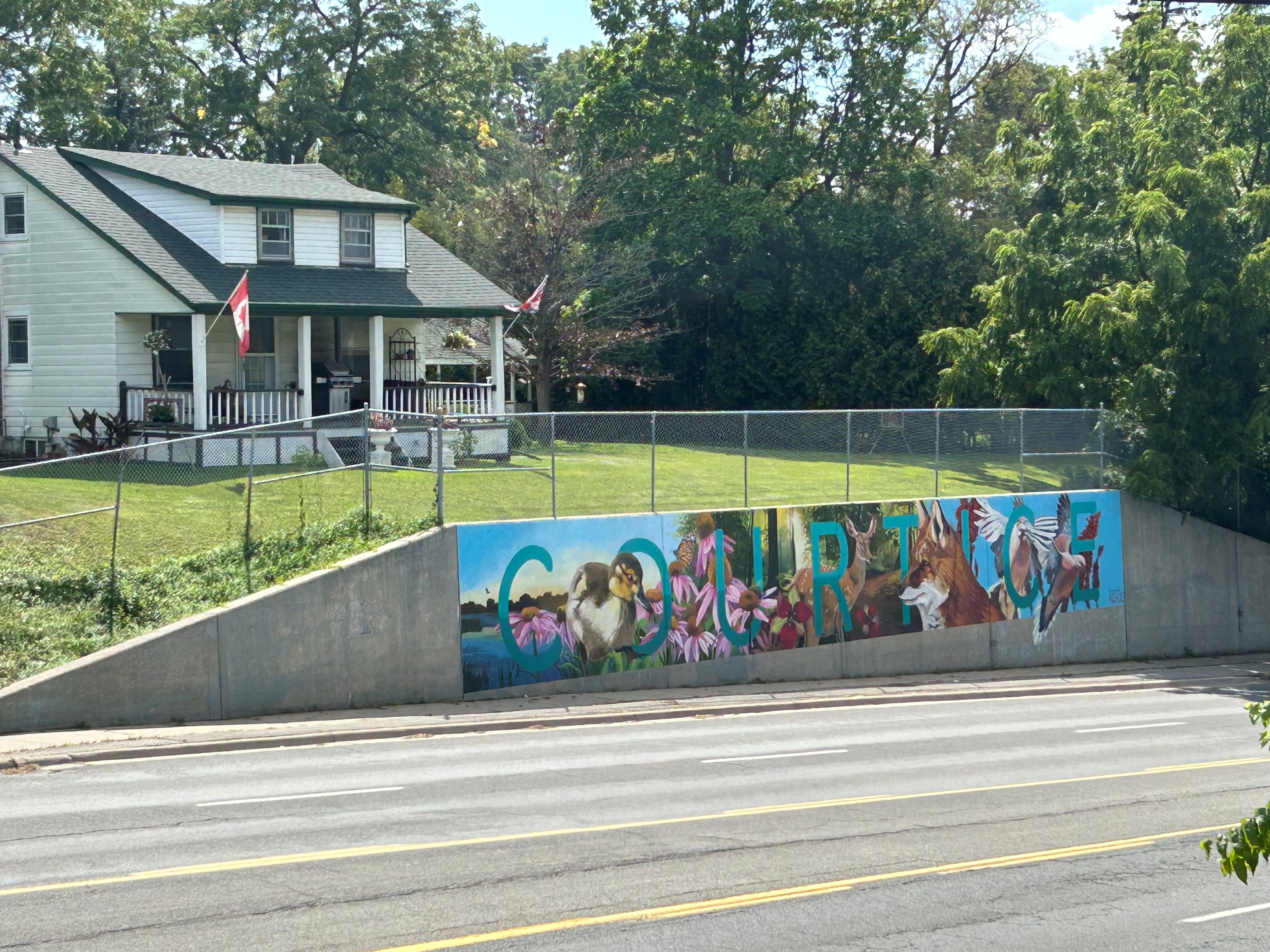
7. “Good Morning, Courtice” by Meaghan Claire Kehoe
Near 1540 Hwy 2, Courtice (south side of Highway 2 between Prestonvale Rd and Centerfield Dr)
Meaghan Claire Kehoe painted this Courtice mural in 2025. Meaghan is a local artist who applied to a call-out by Durham Region for a public art project.
In an interview on the podcast ‘Exit 425,’ Kehoe stated that her inspiration for the mural came from community members’ contributions. For example, this mural features a fox, which Meaghan learned was an important part of the natural wildlife in the area. Capturing flora and fauna was a main theme the community voiced interest in seeing reflected in their art.
The artist’s goal was to create something “timeless,” noting that the art belongs to the people of the area once she completes the mural.
More information:
- Artist interview:
https://youtu.be/Borfn0hSkO4?si=RGyK9U2oasx6jGl0 - Meaghan Claire Kehoe:
https://www.meaghanclairekehoe.com/about
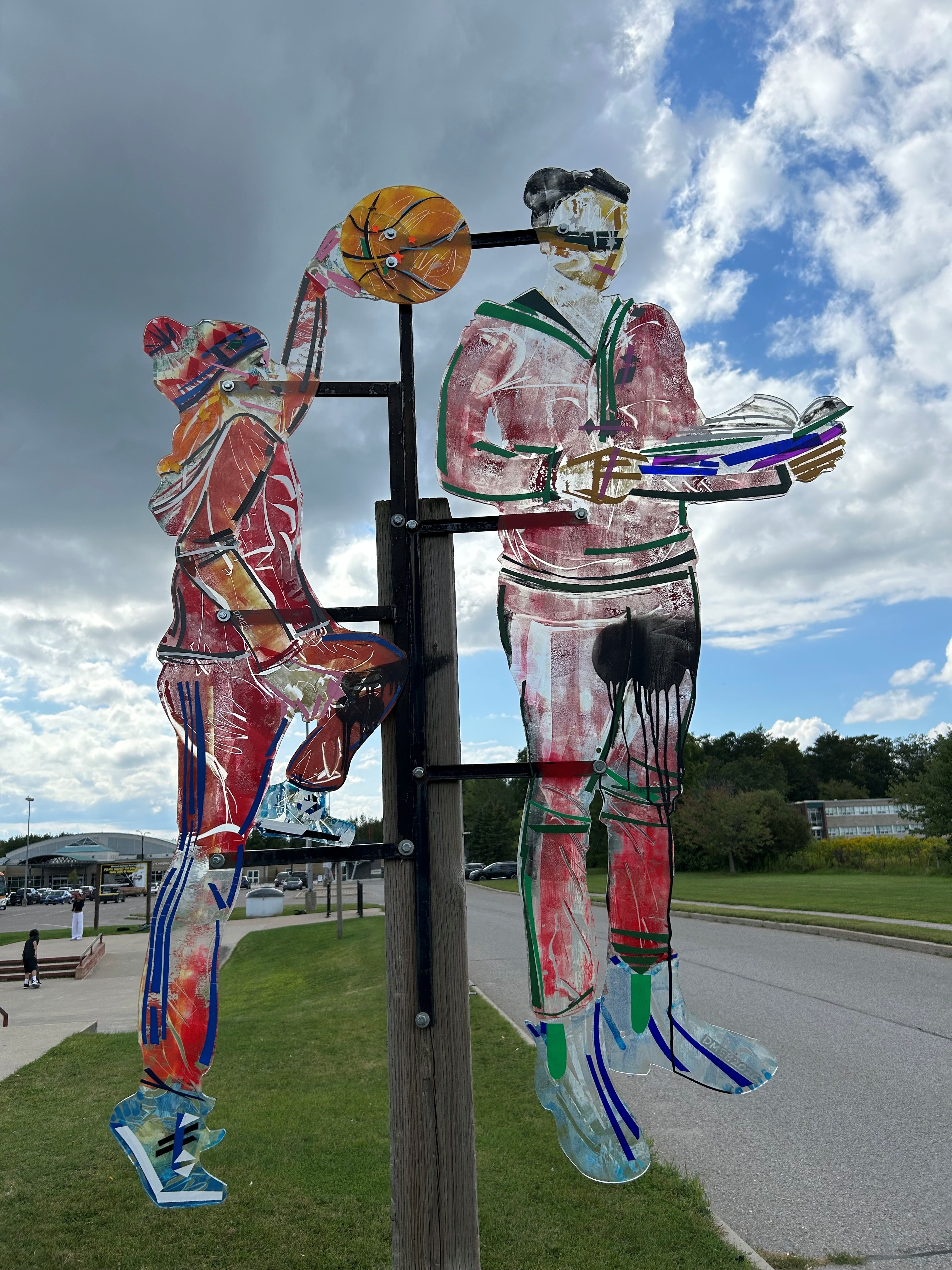
8. “Silhouettes” by Darlene Bolahood
Along Hwy 2, Courtice (with some at the Tooley’s Mill Park entrance at 1492 Hwy 2)
In 2020, the artist Darlene Bolahood was commissioned to create a series of coloured polycarbonate figures as an outdoor installation for Courtice. The project was funded through a grant that was part of a series of public art installations in Courtice, Orono, and Newcastle.
Bolahood’s art symbolizes local youth and members of the Courtice community. In a 2020 interview, the artist described: “The themes of the installations will reflect the energy of the community and its narrative and (are a) tribute to the youth of our community and the notion of many styles of family in action.”
More information:
- "Clarington downtowns to see installation of new public art this spring," Municipality of Clarington:
https://www.clarington.net/news/posts/clarington-downtowns-to-see-installation-of-new-public-art-this-spring/
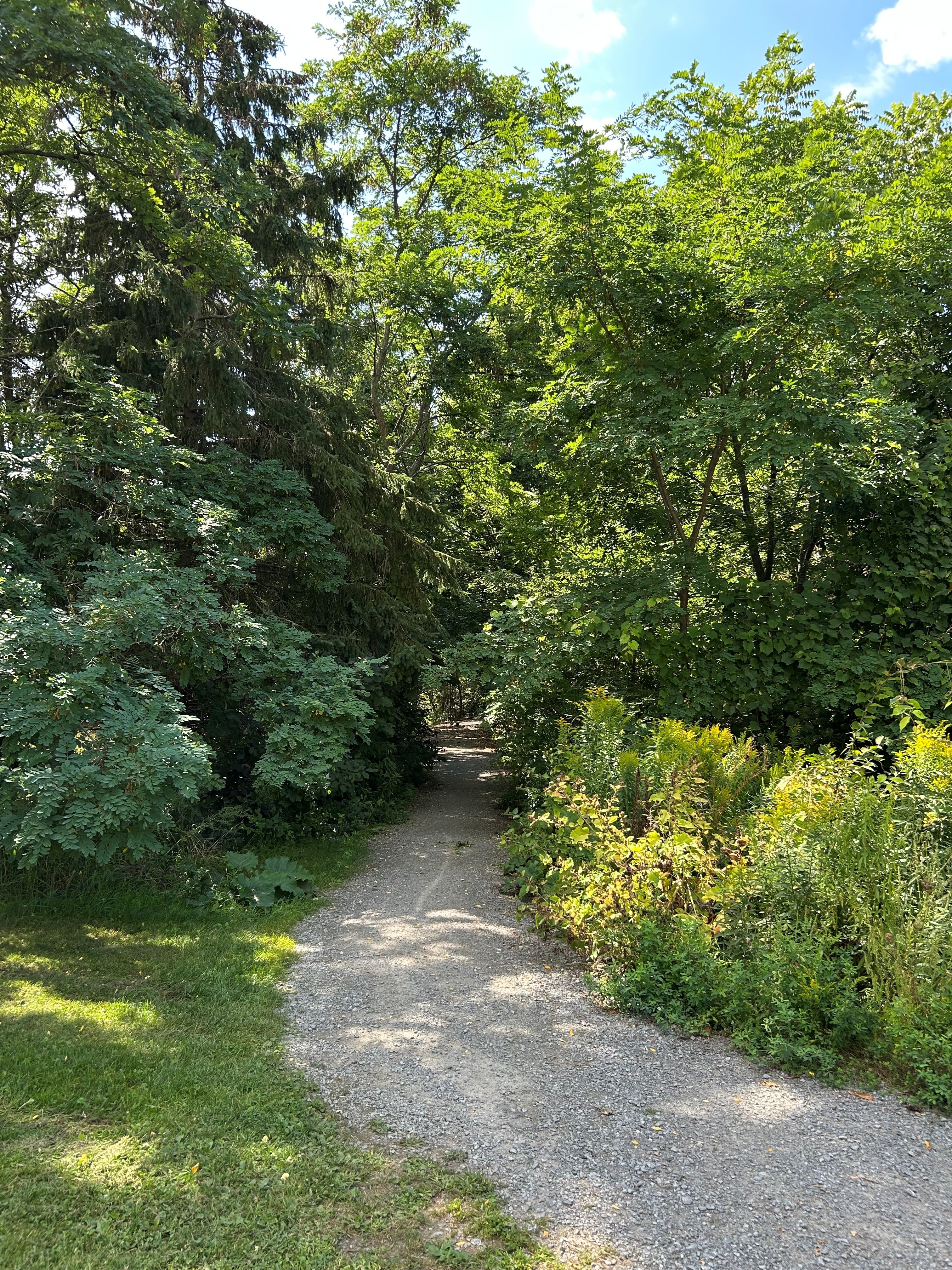
10. Courtice’s Unofficial Duck Pond
Near 70 Robert Adams Dr, Courtice
When you stop by the unofficial duck pond in Courtice, you may see birds—from ducks to cardinals to herons—as well as other animals: such as turtles and fish, depending on the season. People can enjoy the outdoors as they explore trails that lead around this water management pond.
Did You Know? Small ponds punch above their environmental weight. Research shows they can support more species than rivers or lakes, making them vital havens for Ontario’s frogs, turtles and ducks.
RELIGIOUS BUILDINGS
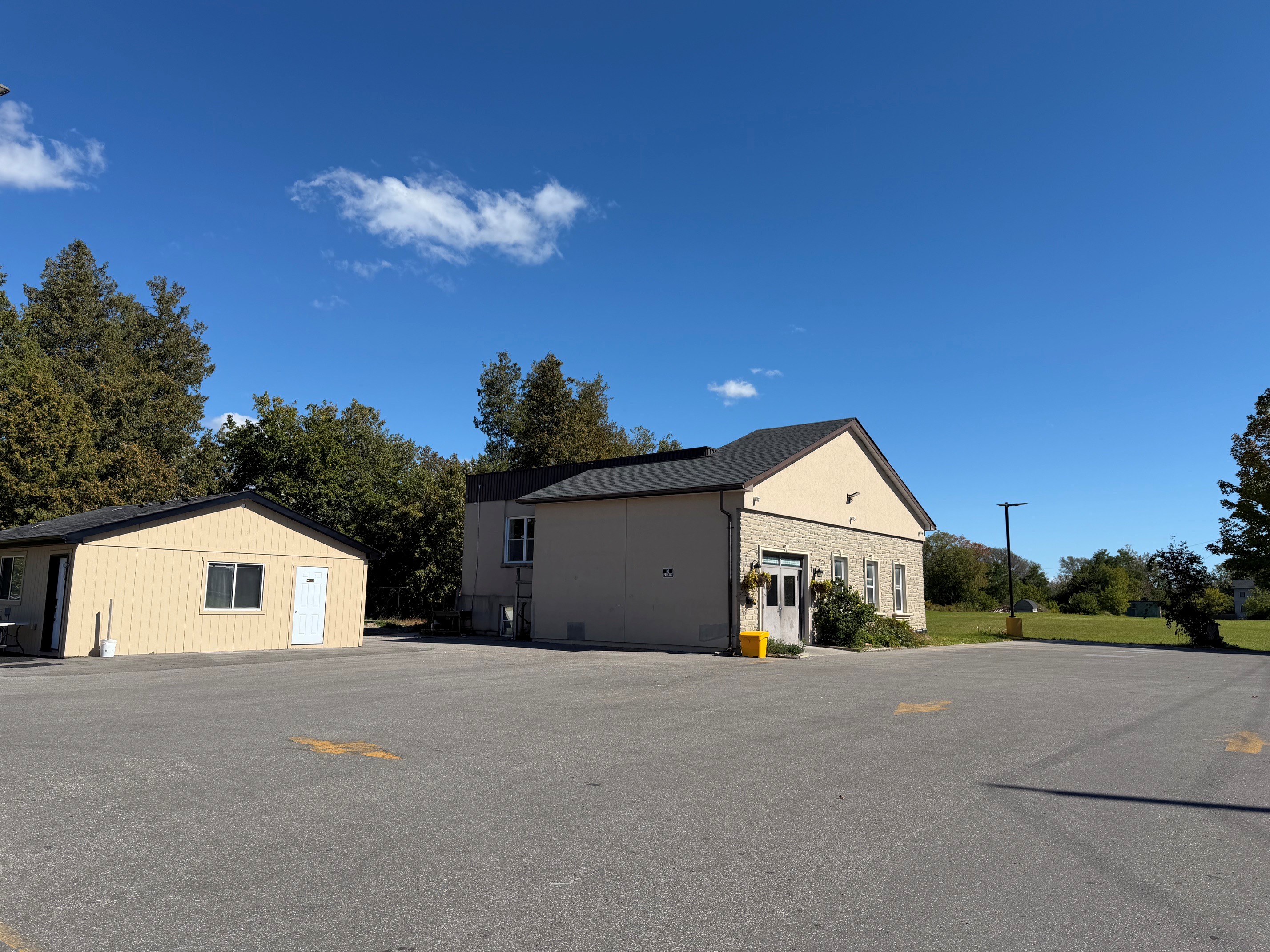
4. Al Rayan Islamic Centre
1660 Durham Regional Hwy 2, Courtice
The building on this site began as Courtice Public School S.S. #8 (or “Mount Carswell” school), which was constructed around 1907. Just fifteen years later, an addition enlarged the structure. This facility served the as a public school until the 1980s, at which time it became a maintenance shop for the school board.
This site next served as a place of worship for the Courtice Baptist Church in the 1990s. This congregation moved out of the building in the 2010s, due to the need of more space.
Now, the building serves its community as another place of worship. According to the Al Rayan Islamic Centre website, this mosque opened in the 2010s and is a welcoming space for worship, learning, and spiritual connection. Their goal is to foster an environment where families grow in faith, youth are empowered, and traditions are honoured.
More information:
- Al Rayan Islamic Centre:
https://www.alrayanislamiccentre.org/
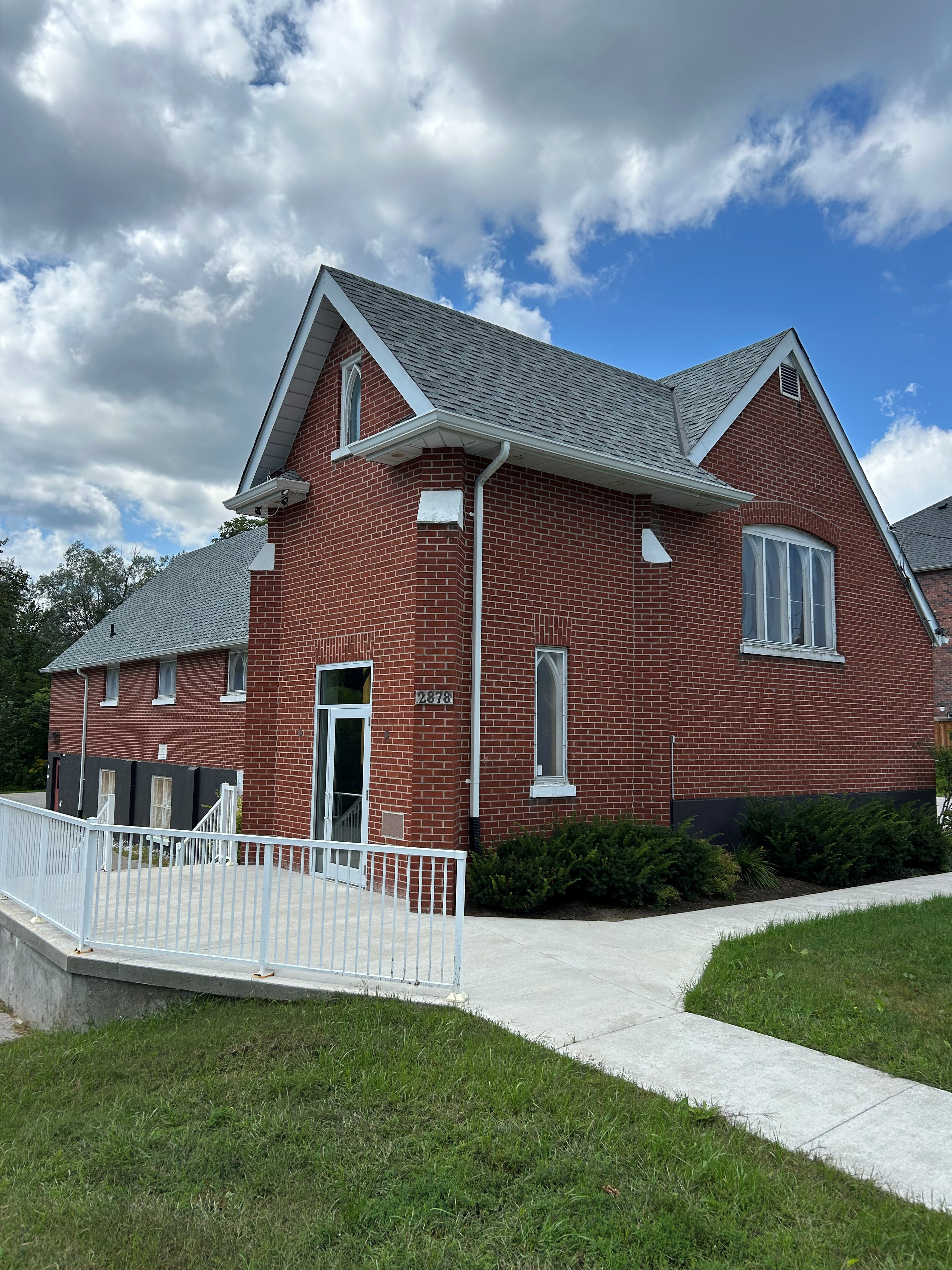
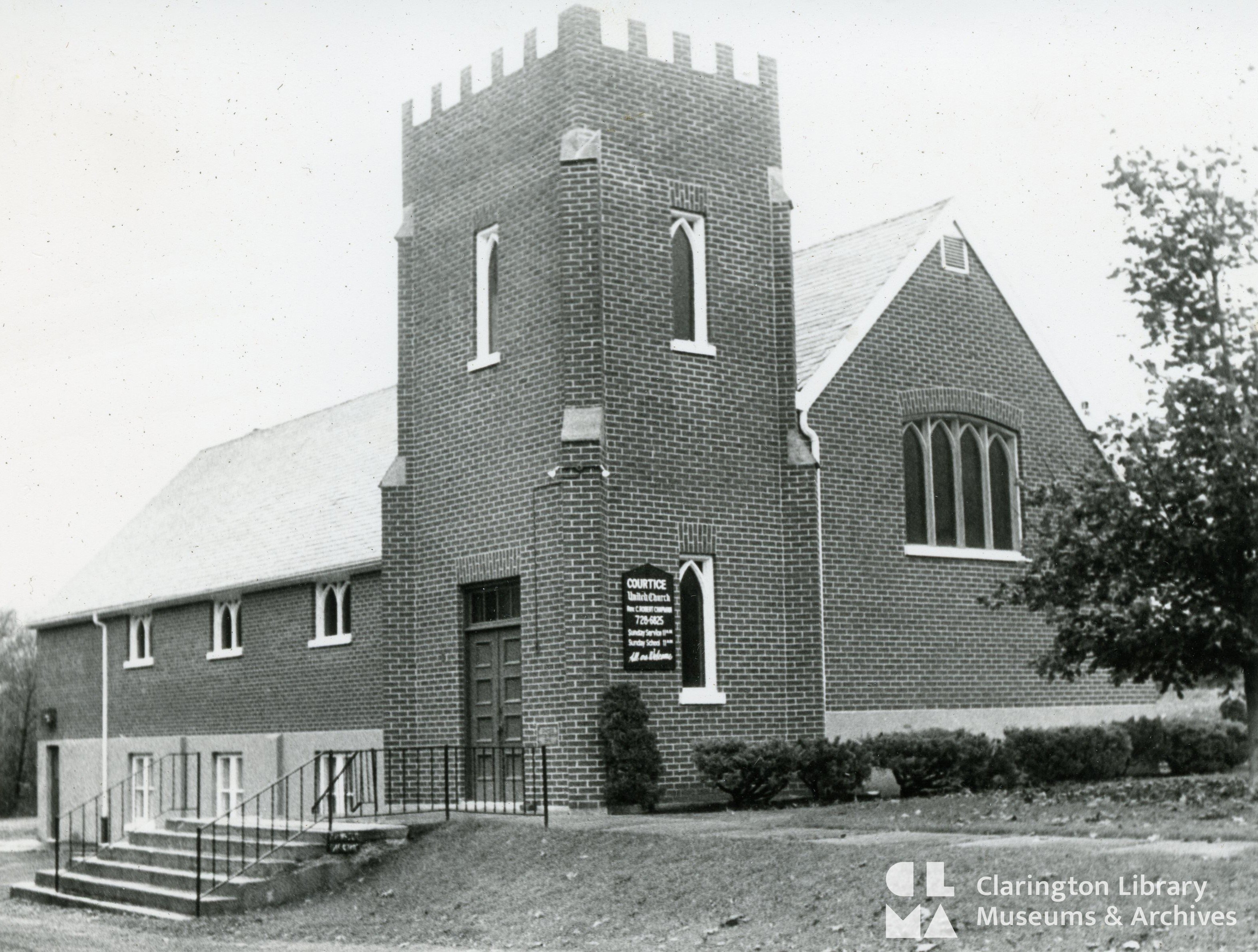
5. Courtice United Church (Fellowship Christian Church)
2878 Trulls Rd, Courtice
Once deemed the “new” Courtice United Church, the story of this building begins in 1946 and was made possible by local fundraising. Soon after, the basement was opened in 1948, and by 1954 the work on the building was finished. Efforts were slow at this time due to the economy post WWII.
Around the time of the dedication of this church in November 1954, congregants gathered historical church documents for a time capsule, and the cornerstone was laid by L. M. Somerrville.
By January 1997, the congregation amalgamated with the parish of St. Andrews United Church of Oshawa, to be known as Faith United Church.
At a later point, the congregation outgrew their building, and Faith United Church now operates out of the building at 1778 Nash Rd, Courtice. The building at 2878 Trulls Road became the Fellowship Christian Church after it was purchased in 1996.
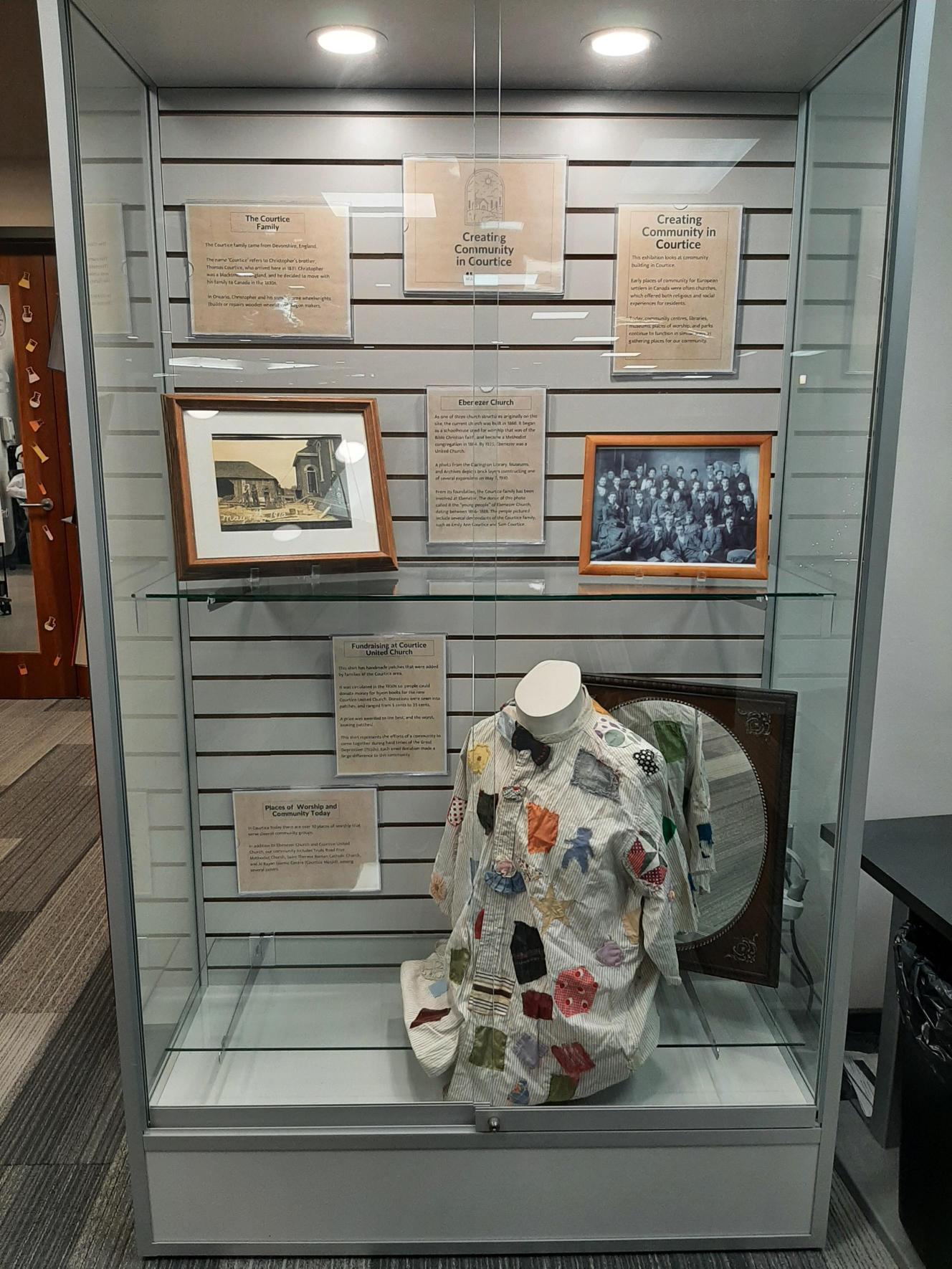
Collection Spotlight: In CLMA’s collection we have a special shirt from the Courtice United Church community onto which patches were sewn to collect donations of money for hymn books. Donations in the 1930s ranged from 5 cents to 35 cents.
A prize was awarded to the best, and the worst, looking patches! This shirt represents the efforts of a community to come together during hard times of the Great Depression.
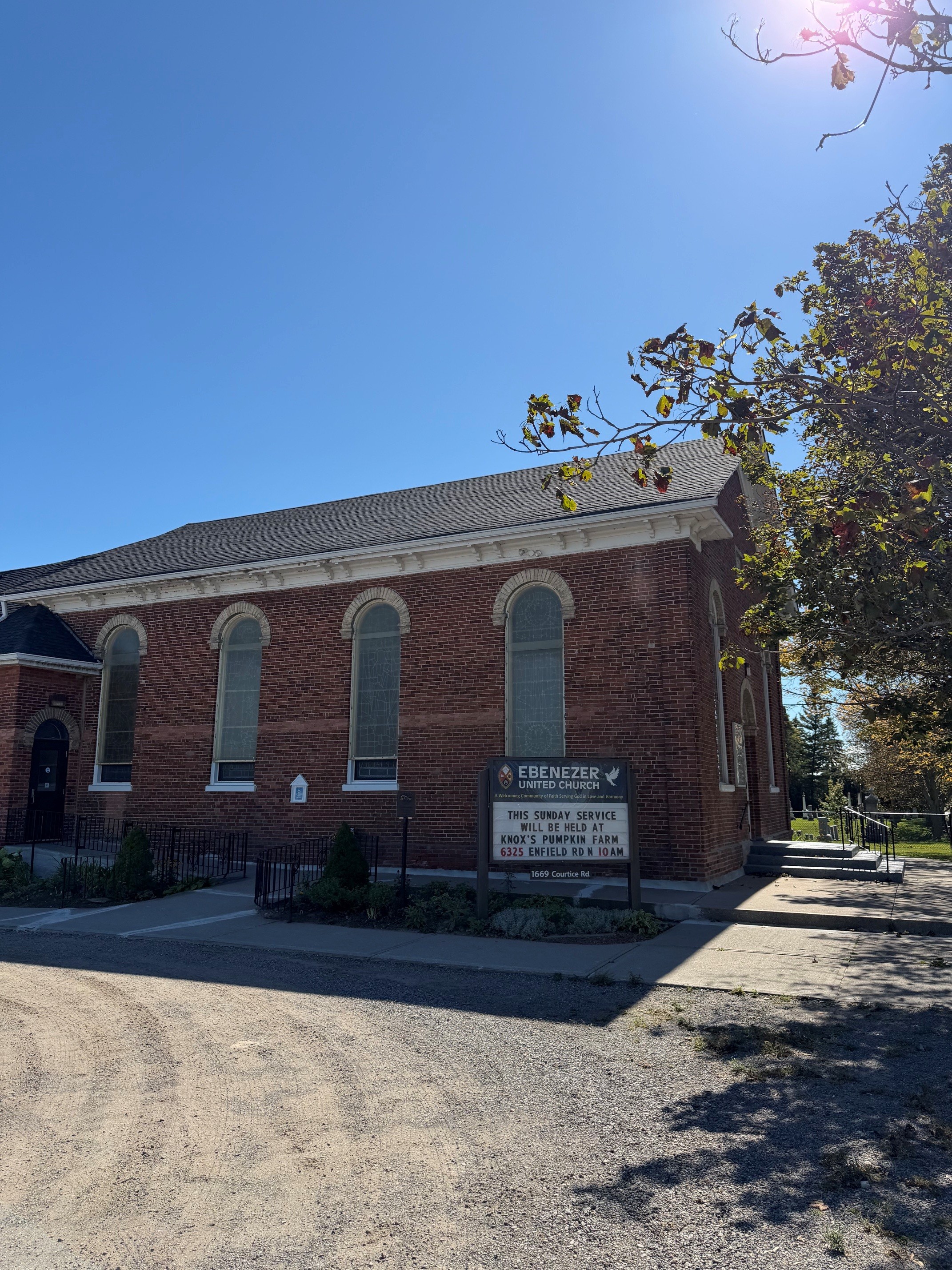
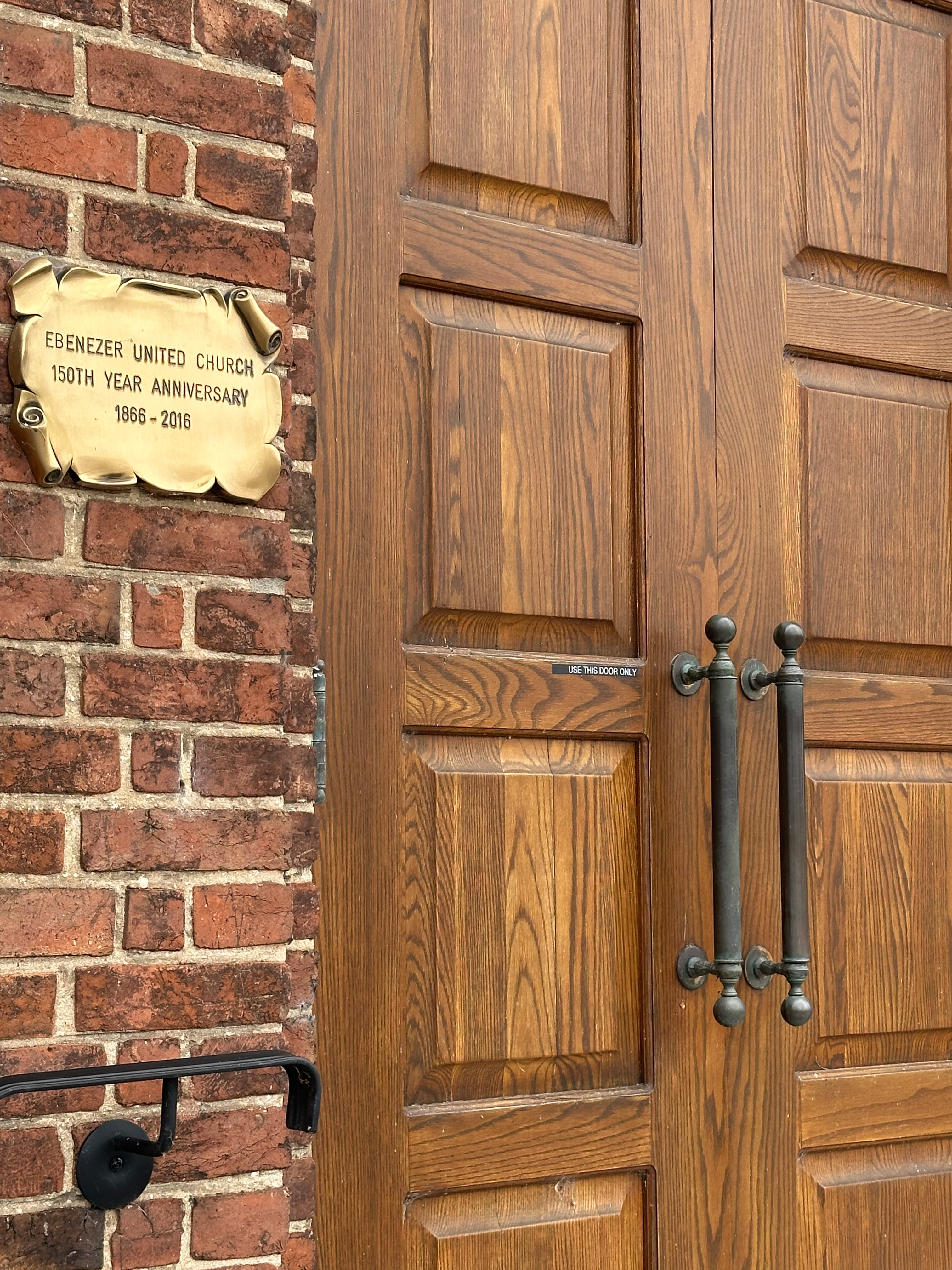
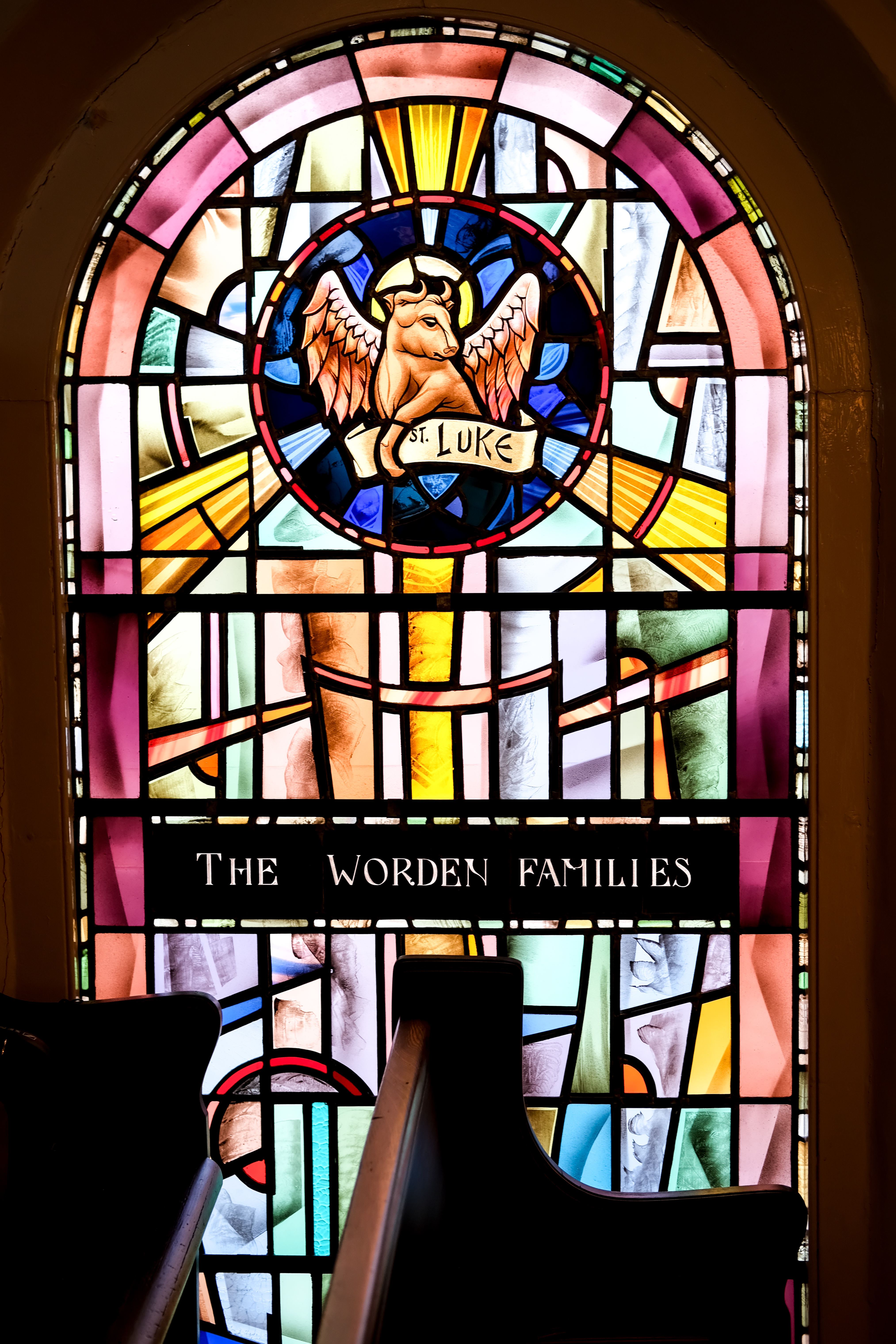
17. Ebenezer Church
1669 Courtice Rd, Courtice
As one of three church structures originally on this site, the current Ebenezer church was built in 1866. It began as a schoolhouse used for worship that was of the Bible Christian faith and became a Methodist congregation in 1884.
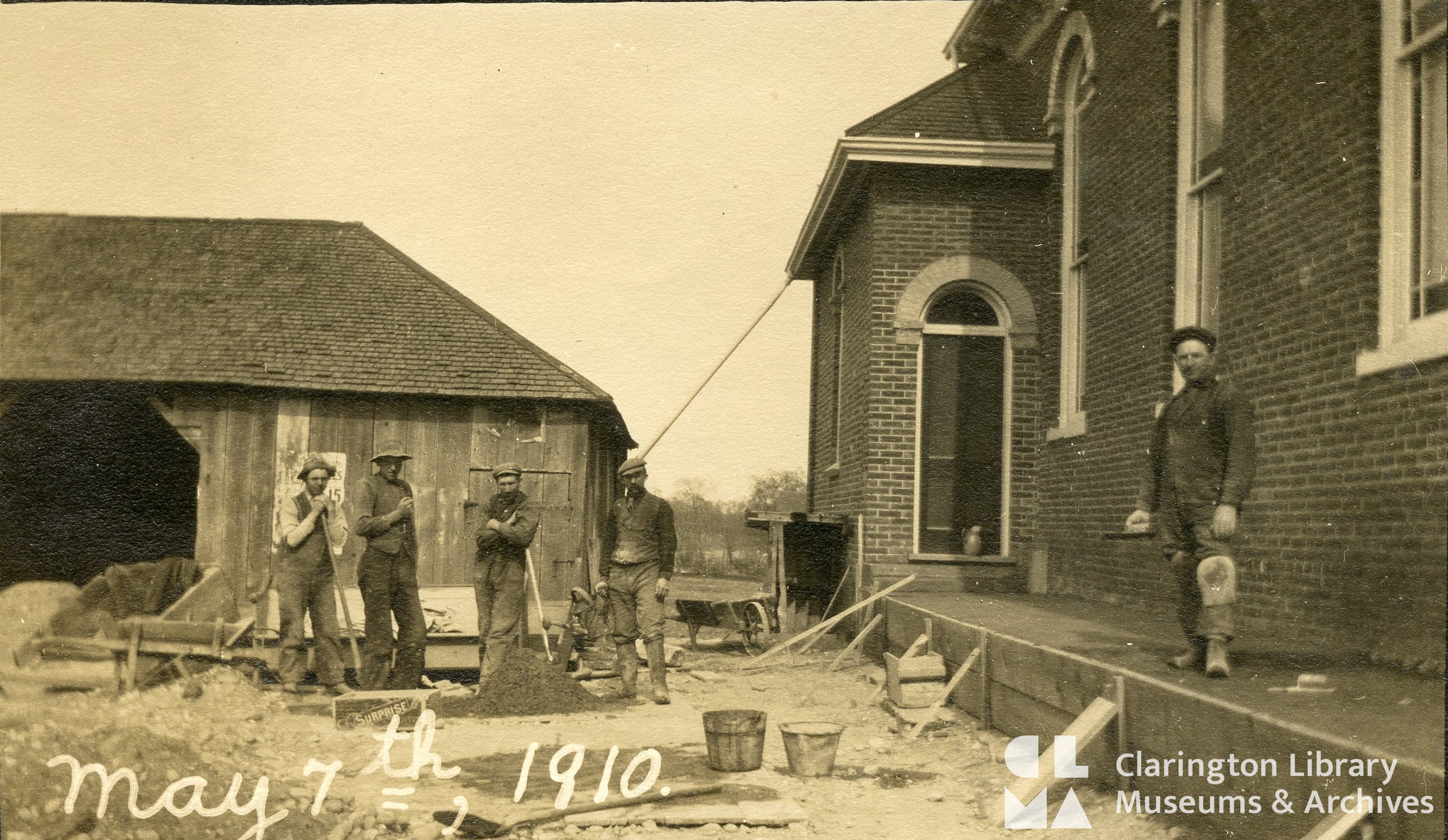
In terms of architecture, this current brick church exhibits the influence of the Greek Revival Style in the low gabled roof, and Italianate style with the rounded windows. Expansions on to the building occurred in May of 1910.
By 1925, Ebenezer was a United Church. Just the following year, in 1926, the church celebrated its Diamond Jubilee.
More information:
- Ebenezer United Church:
https://www.ebenezerunitedchurch.ca/ - Heritage Plaque, Ontario Heritage Trust:
https://www.heritagetrust.on.ca/plaques/bible-christian-church - Ebenezer Church History, Diamond Jubilee, The Canadian Statesman (25 Nov 1926, p. 5):
https://vitacollections.ca/claringtonnews/2713421/page/7
THEN & NOW
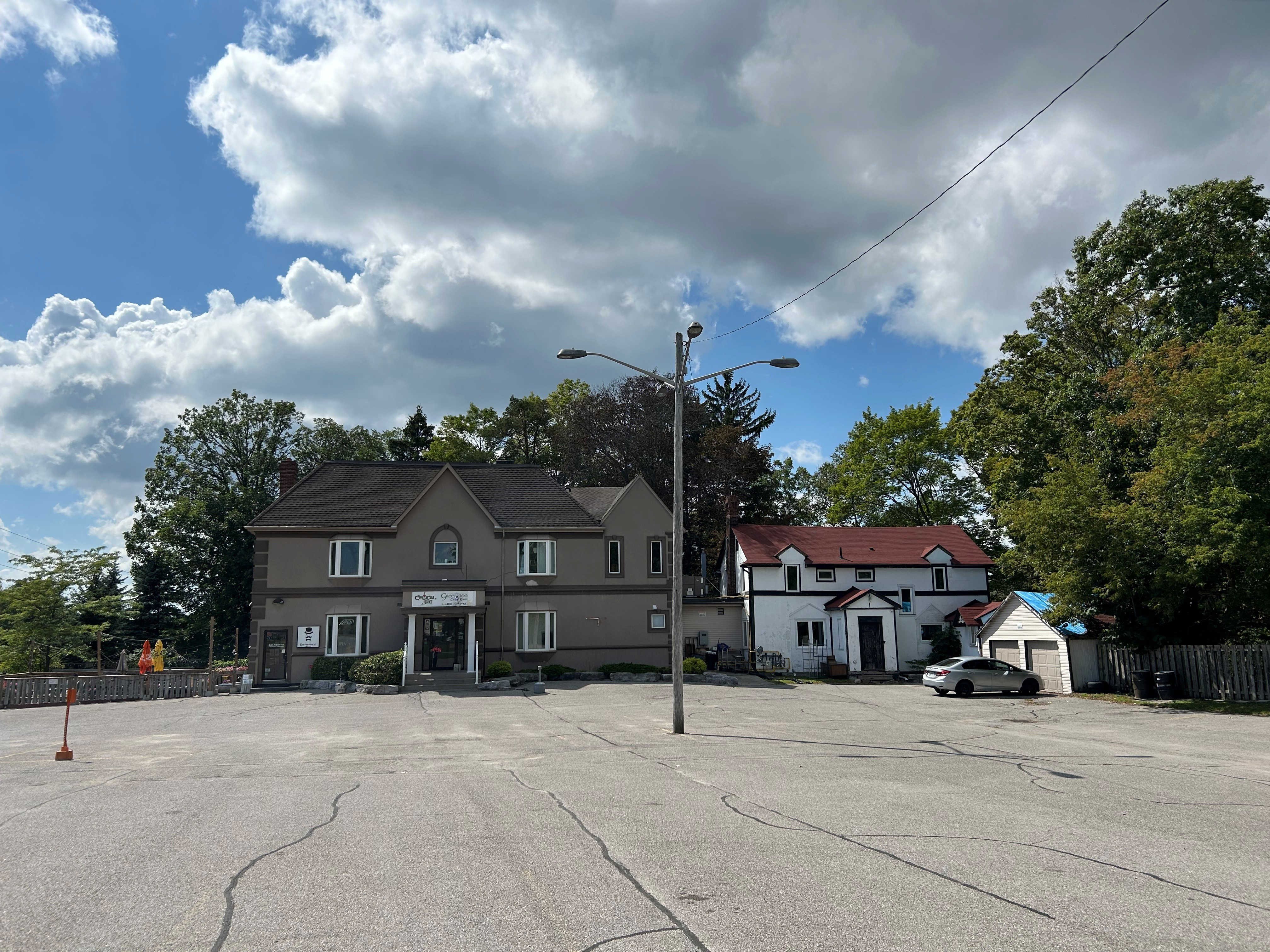
6. Hilltop (Sir Monty’s, Critical Hit)
1540 Durham Regional Hwy 2, Courtice (north-east corner of Highway 2 and Farewell Creek)
While this site has undergone many changes over the years, a core part of this structure began as a house built in 1930 for Robert Preston. Preston was a former mayor of Oshawa, and the source of the name “Prestonvale” for the small area around this hilltop.
Before the 1930s, the area was referred to as “Black’s Hill”. Apparently, one of the first Post Office for Darlington was located nearby. Later, recreation facilities were established, including the campground named Wonderland Park with rental cottages, and a swimming hole called “Happy Hollow.”
In terms of the present buildings, this site has hosted many businesses, including: The British Bulldog restaurant and Tanglewood bar (c.1980s to early 2000s). It then became Hilltop Restaurant (closed 2011), and Stuttering John’s Smokehouse. Today it operates as Critical Hit Gaming Lounge upstairs and Sir Monty’s brewery in the basement.
More information:
- Sir Monty's Brewing Company:
https://sirmontys.com/ - Critical Hit Gaming Lounge:
https://criticalhitgaminglounge.com/
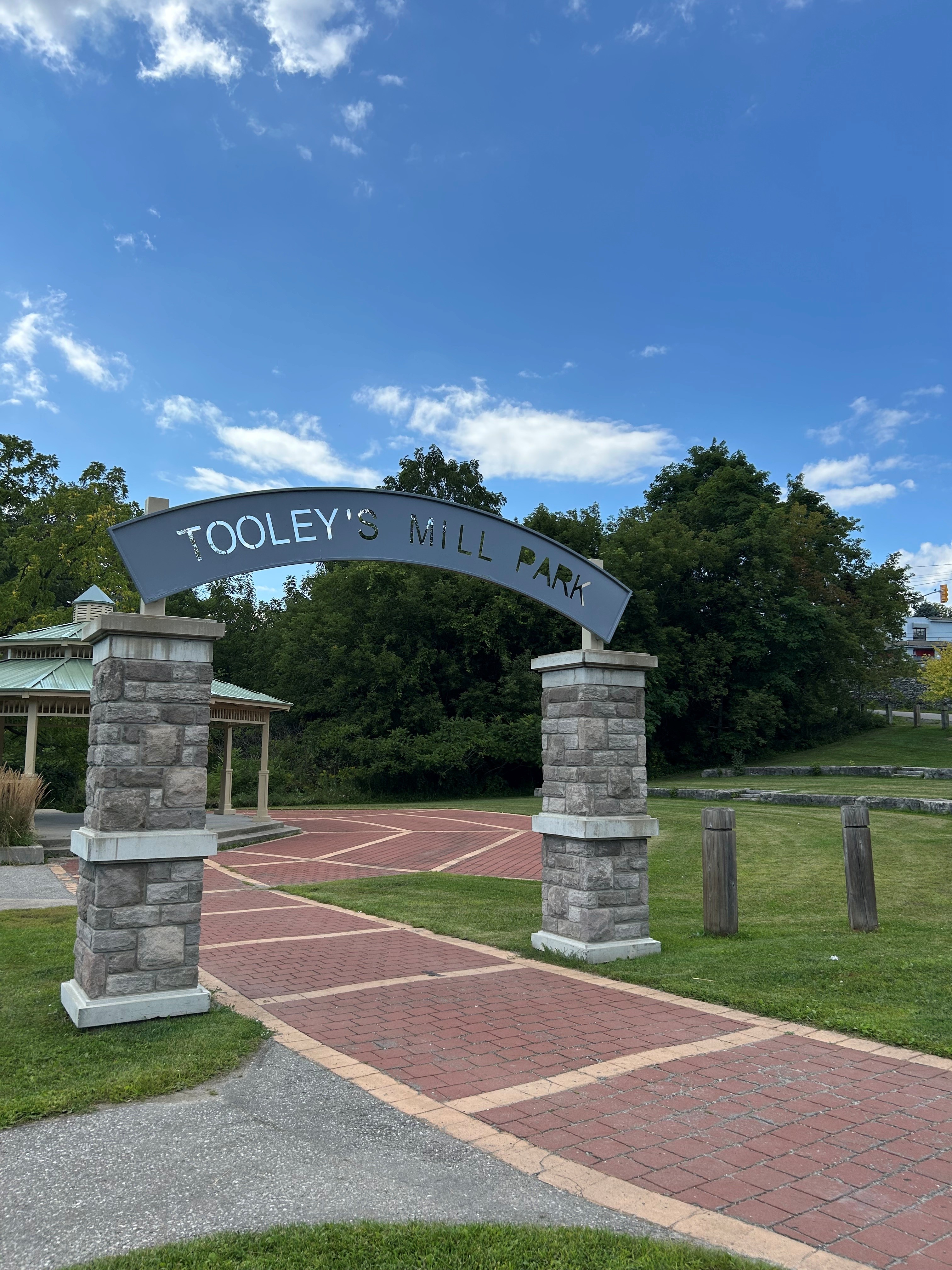
9. Prestonvale Tourist Camp (Tooley’s Mill)
71 Old Kingston Rd, Courtice
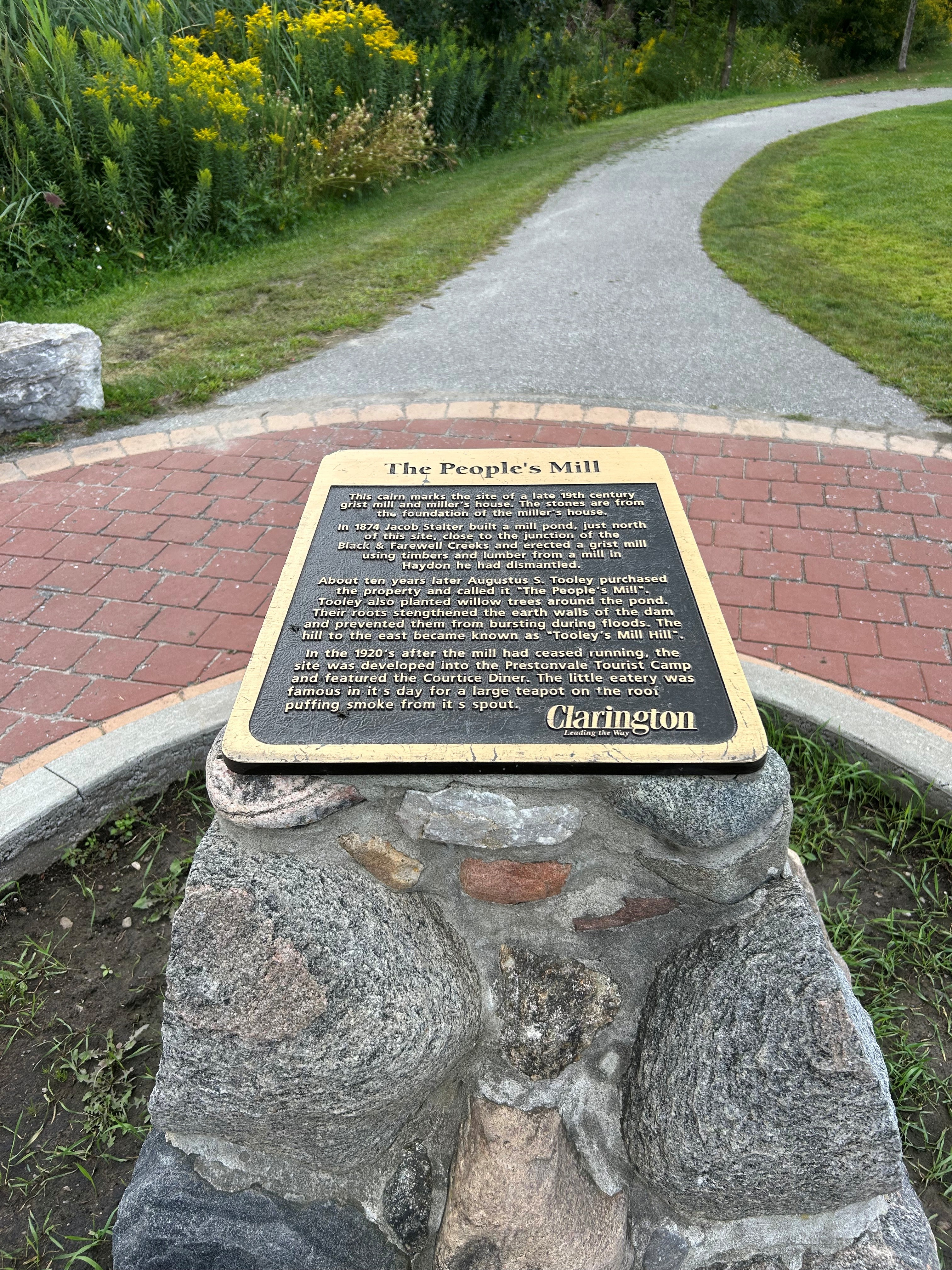
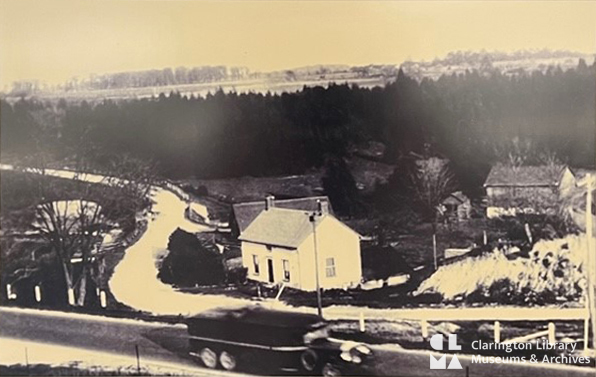
This area was first owned by Jacob Stalter in the 1870s who established a grist mill. Later, it was owned by the Augustus S. Tooley family and served the community as a grist mill that was named “the People’s Mill.” In his obituary, Augustus was remembered as one of the "pioneers" in the field of milling in our area (Canadian Statesman, 11 Jan 1934, p. 6).
After the 1920s, this site was developed to become Prestonvale Tourist Camp. This summer camp offered a pool, shuffleboard court, and camping grounds for tourists.
Check out the Municipality of Clarington heritage plaque in the park to learn more!
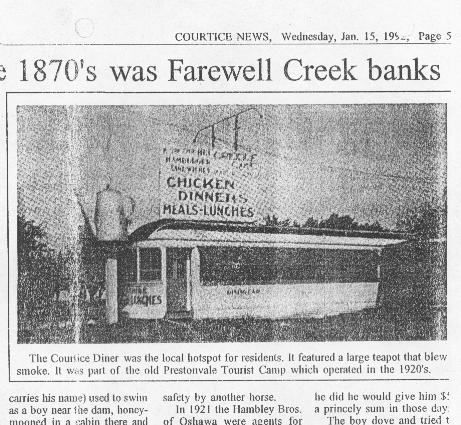
Do You Remember: Here you could also find the Courtice Diner. The diner was famously marked by a large teapot sign that puffed out smoke.
More information:
- Obituary for A.S. Tooley, The Canadian Statesman (11 Jan 1934, p. 6):
https://vitacollections.ca/claringtonnews/2713791/page/7
20. W & D Courtice Memorial Park
2203 Courtice Rd, Courtice
Today this park serves as a place to play soccer and cricket, but its history goes back further than the early 2000s, at which time the Municipality of Clarington graded the fields for soccer.
According to local lore, the park land was donated to Ebenezer Church in September 1950 by a member of the Courtice family: Kenneth Eugene Courtice (1890-1977), who was a grandson of Christopher Courtice. The intended use was shared by Ebenezer and Courtice United Churches.
By the mid 1950s, the Municipality approached the churches to form an understanding of recreational use at the park, except for on Sundays. At that time, softball was the primary sport played here.
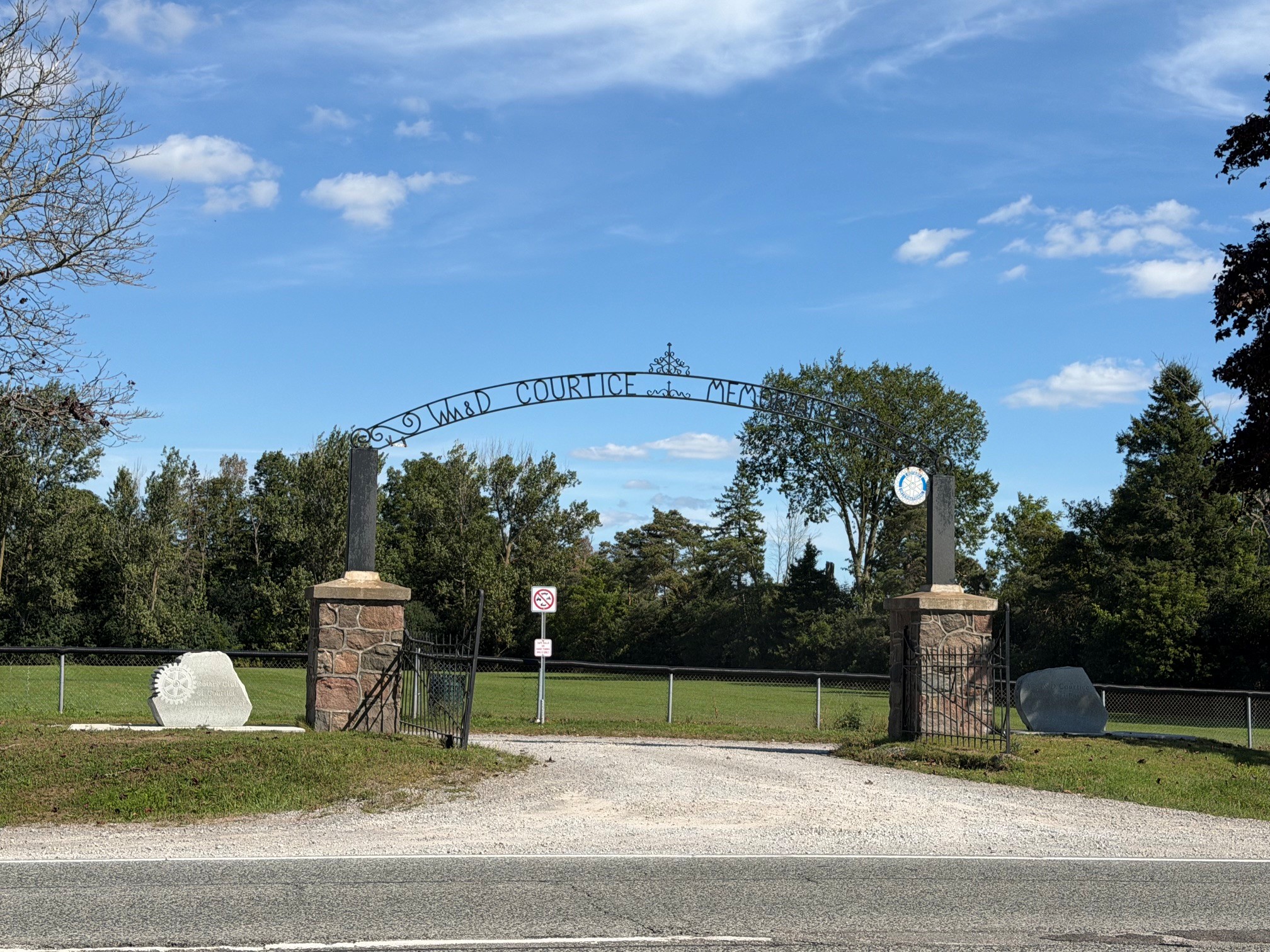
The iron sign over the entrance is a reminder of the Courtice family’s role in this area. The W. on the sign stands for William Courtice (1856-1931), father of Kenneth. The D. in the sign signifies a memorial to Dean Eugene Courtice, son of Kenneth and his wife Gerda, who unfortunately passed away in early childhood (1922-1925).
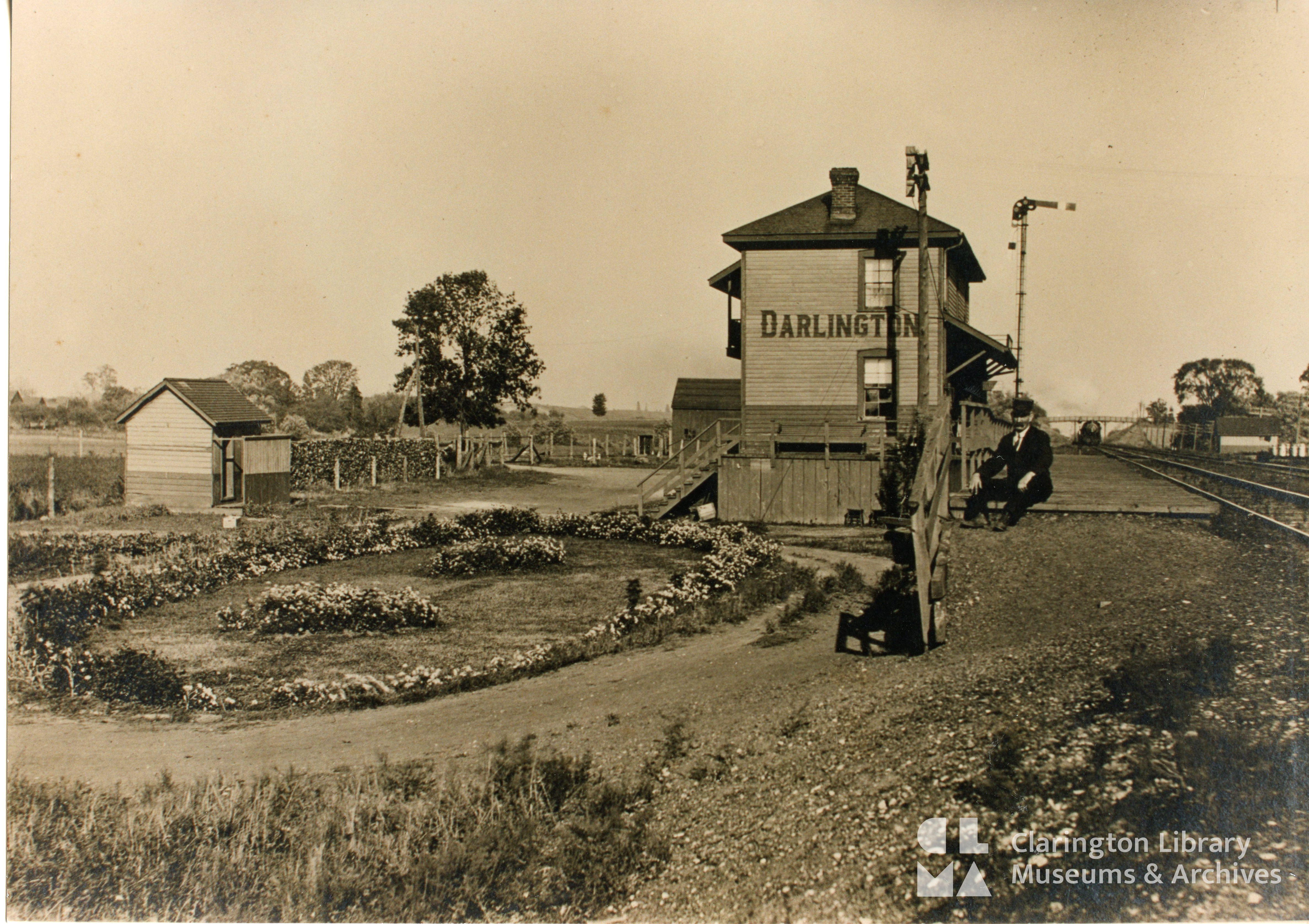
Railway Stations in Courtice
There were two railway stations located in Courtice: one was north of Baseline Road, close to Prestonvale Road, and the other was located closer to where Ontario Power Generation is located now. The Grand Trunk Railway/Canadian National Railway would have been the one further south toward the waterfront (at the base of Solina Road, slightly east), and the other more towards Prestonvale was the Canadian Pacific Railway Station.
Residents recall that farmers benefited from the connection to Toronto and would send milk and eggs from Darlington stations to the city by train. This was especially important during the winter months when the harbours were frozen over for shipping. Trains also ran through the station to carry passengers.
The Grand Trunk Railway was first opened in the 1850s but later was taken over by the government to become the Canadian National Railway after 1923, due to financial failure. Still today, the line is used for freight transport and by VIA Rail.
The Canadian Pacific Railway opened in 1914, chartered as the Campbellford, Lake Ontario and Western Railway. Station maintenance was a priority for CPR, and the railway encouraged stationmasters to cultivate attractive gardens and neat grounds, even running contests to incentivise this practice.
HERITAGE HOMES & FAMILIES
11. Simon Penfound House
2320 Prestonvale Rd, Courtice (west side of Prestonvale Rd, opposite of Oke Rd)
The Penfound family is remembered as one of the early settler families of Darlington Township. Simon Penfound had a house built here, and he married Acy Anne Rundle, daughter of another early settler family, Charles and Susan Rundle. Acy and Simon continued to work their family farmstead until the passing of Simon.
In her obituary in 1947, Acy is memorialized as a devote member of the Ebenezer United Church and active participant in the W.M.S. She had a love of music, which she imparted on her six children.
12. Old Bloor Street House
1440 Gord Vinson Ave, Courtice
This property is on the Municipality of Clarington’s Heritage Register. It was recommended for designation in 2019, based on several architectural characteristics: namely, the building material of stone cut ashlar laid in a broken course pattern, and the Gothic and Greek Revival elements--including the columns and the decorative barge board along the pointed gable. The Municipality also notes that William Everson, an early settler farmer, was likely the first owner of the house.
More information:
- Planning Services Report, Municipality of Clarington (23 Apr 2019):
https://weblink.clarington.net/weblink/0/edoc/226291/PSD-025-19.pdf
13. William Stevens House
1467 Prestonvale Rd, Courtice (east side of Prestonvale Rd, south of South Courtice Arena)
This house was designated by the Municipality of Clarington in 1996 (by-law 96-71). Built for William Stevens (or Stephens), it is an example of a Gothic Style farmhouse with a central gable. Constructed out of fieldstones, the structure likely dates to the 1860s. In addition to the notable facade, interior features of heritage merit include the original staircase with a decorative newel post, wood window casings, and baseboards in the front of the house.
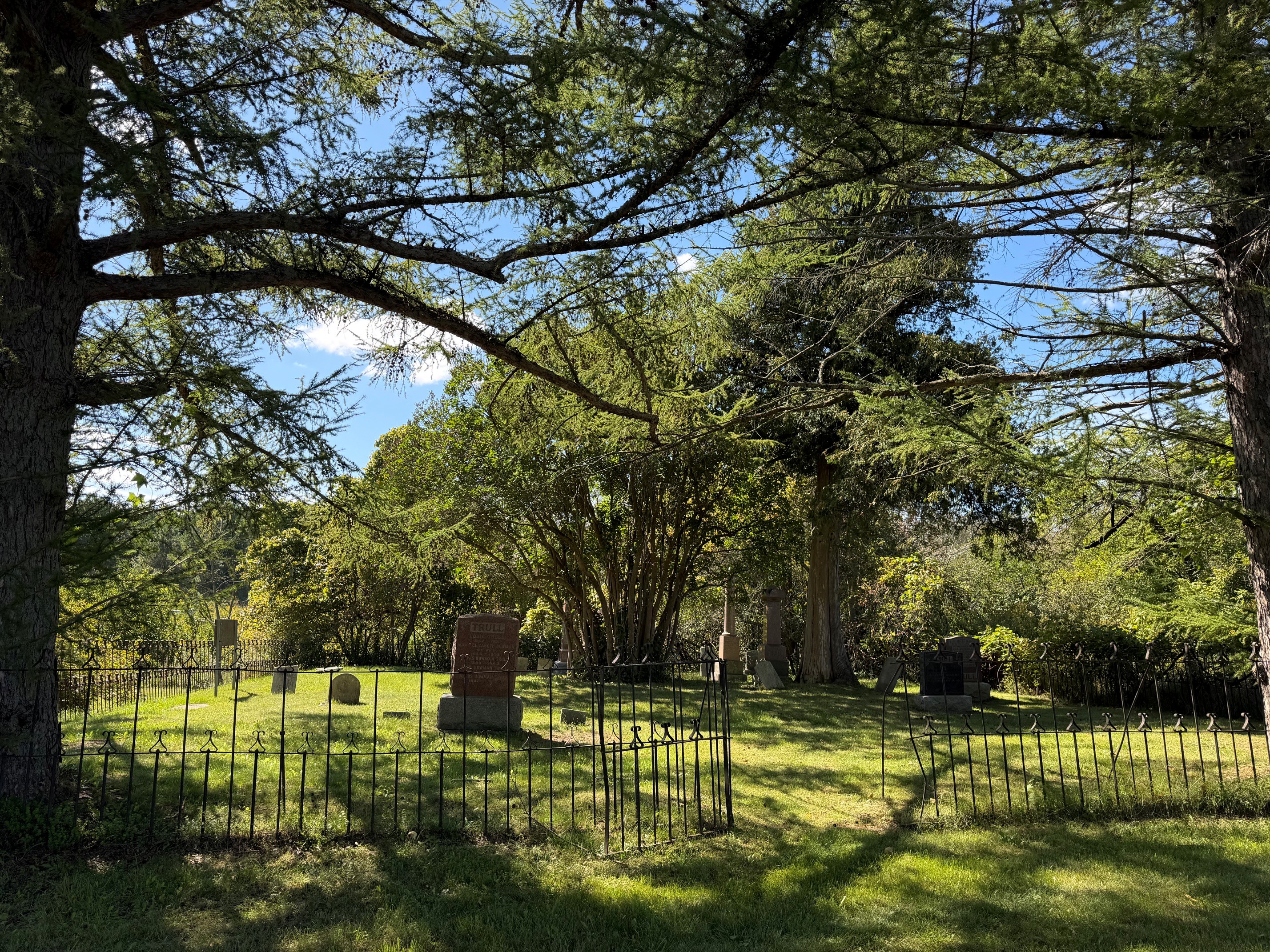
14. Trull Cemetery
Baseline Rd, Courtice (west of Dom’s Auto Parts on Baseline Rd)
The Trull Family Cemetery is located on Baseline Road West between Trulls Road South and Prestonvale Road, west of the Jessie Trull House.
This small, family cemetery was reportedly created by Jesse Trull. His house stands further along Baseline Road. There are a number of Trull family members buried in this small cemetery, which is surrounded by a wrought iron fence.
More information:
- History of the Trulls in Darlington, The Canadian Statesman (8 Nov 1951, p. 6):
https://vitacollections.ca/claringtonnews/2714747/page/7
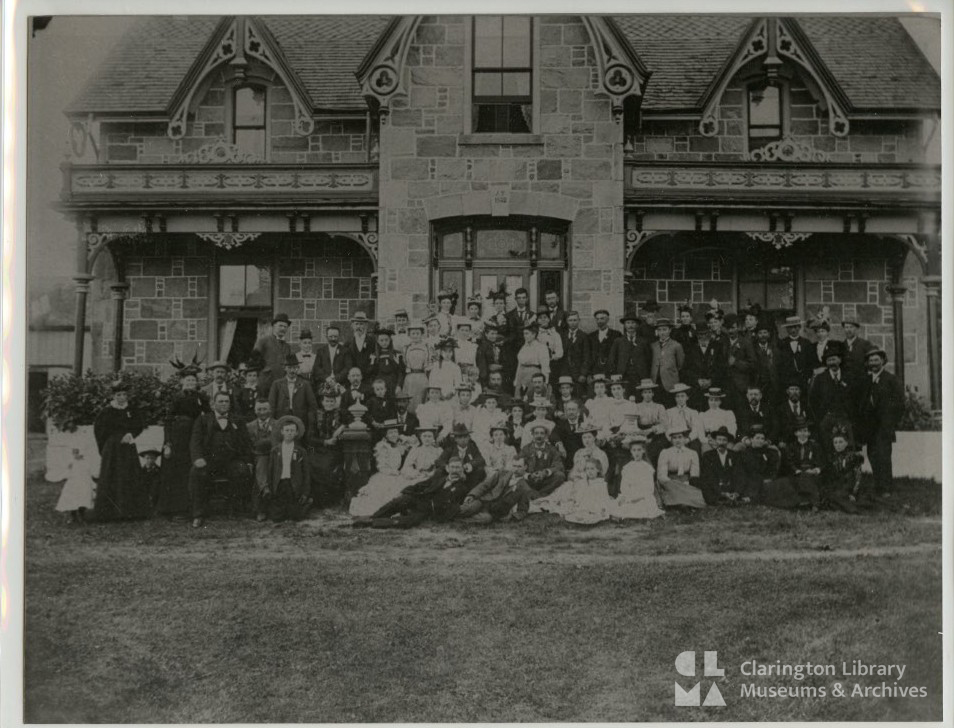
15. Jesse Trull House
1598 Baseline Rd W, Courtice (near Dom’s Auto Parts)
With a datestone over the door that reads “J.T. 1872,” this property on the north side of Baseline Road was once home to Jesse Trull. Architecturally, the house is Gothic Revival in style and was constructed of field stones. Jesse Trull’s house is also illustrated in the 1878 Belden’s Atlas.
16. John C. Trull House
(South side of Base Line Road, Courtice, east of Courtice Rd)
[Historical site of the past; building no longer standing]
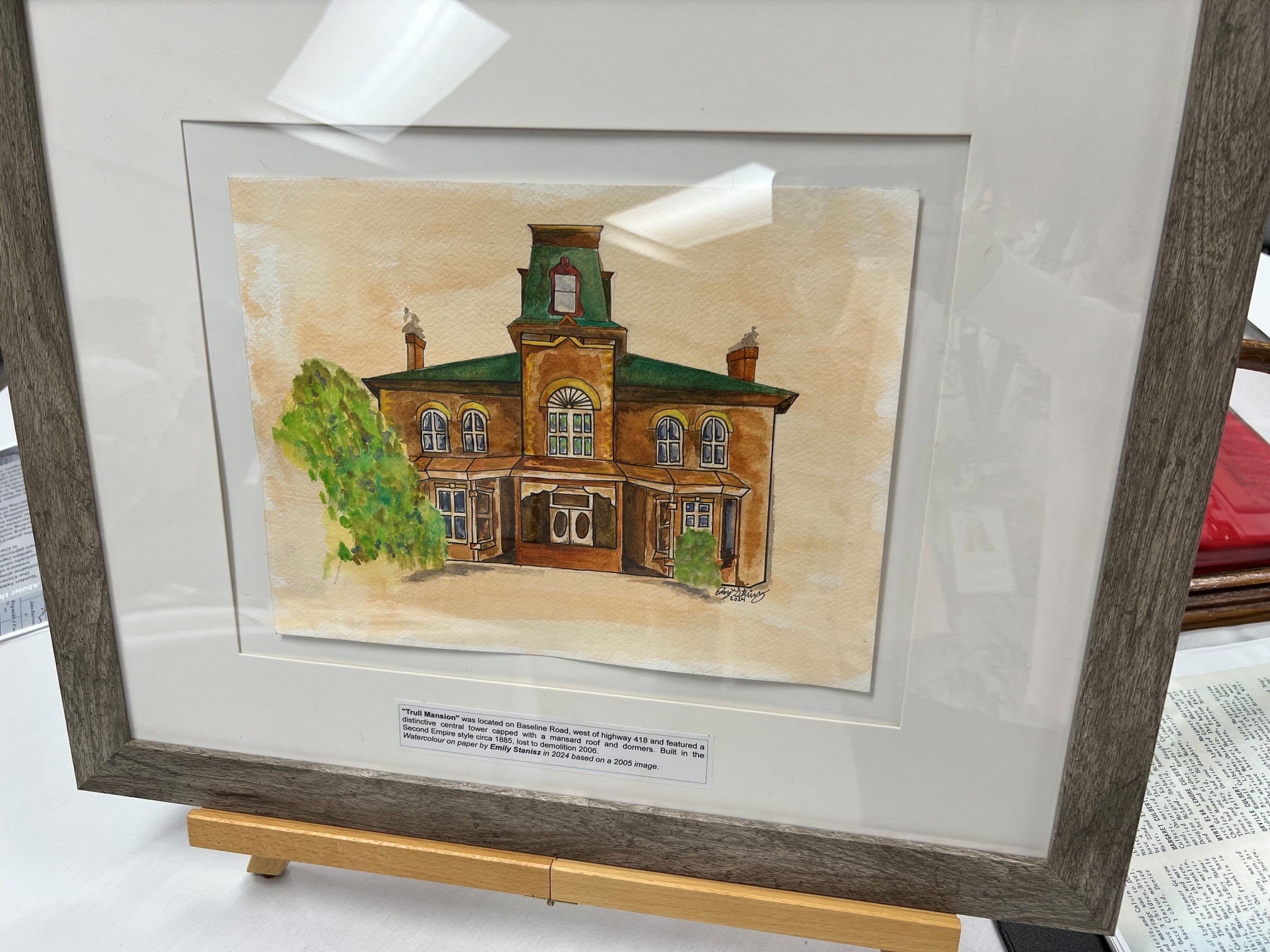
The John C. Trull House, C. 1885, was on the south side of Base Line Road, east of Courtice Road. This house was distinctive because of its central tower capped with a mansard roof and dormers. Also notable: the Second Empire style and only example of this architecture in Darlington Township. John Trull was listed as owner on both the 1861 Tremaine County Map and 1878 Belden Atlas. This house was demolished around 2005 to make way for the Highway 418 construction. It was commonly referred to as the “Trull Mansion” or “Trull Manor.”
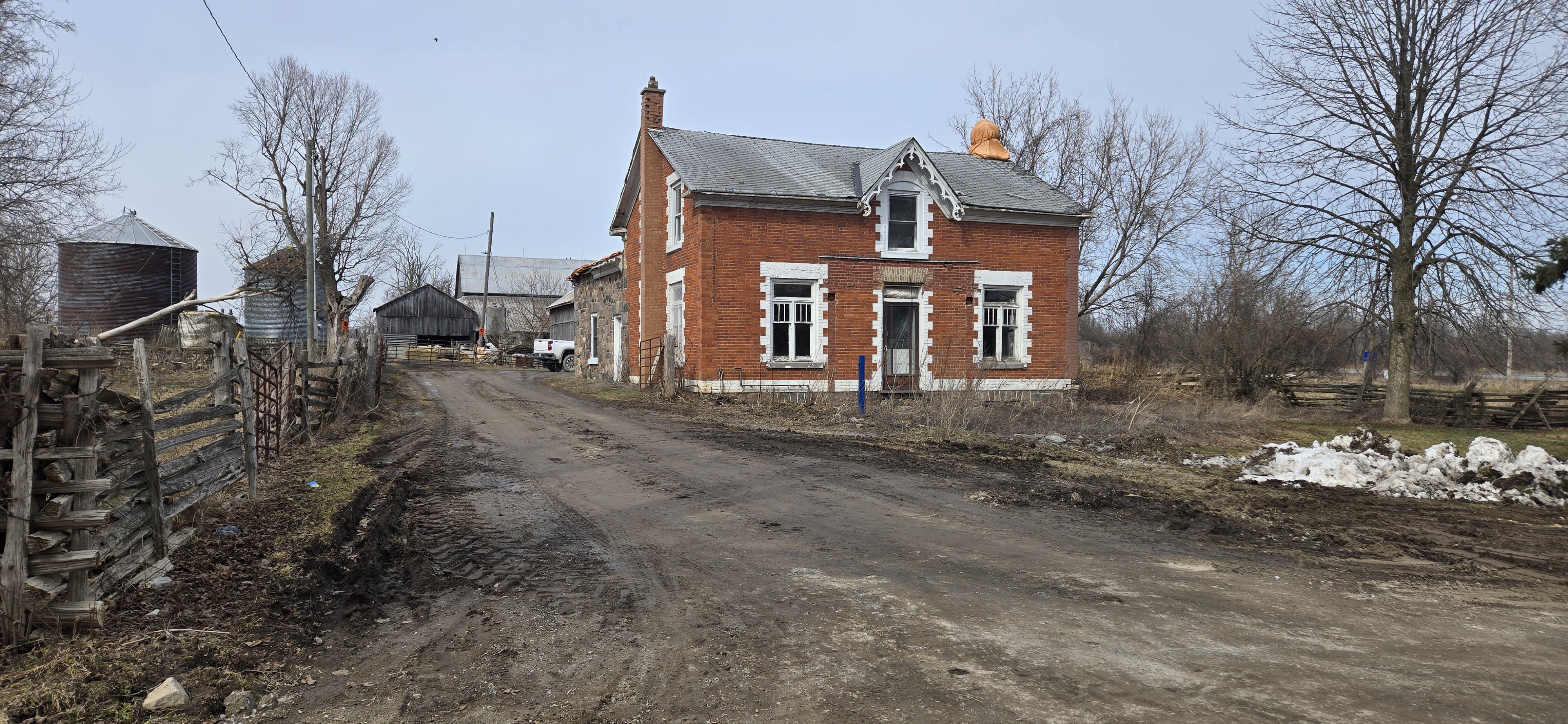
18. Christopher Courtice House, “Lower Alsworth”
(2203 Courtice Rd, Courtice)
[Historical site of the past; building no longer standing]
The Courtice family came from Devonshire, England. The name Courtice refers to Christopher’s brother, Thomas Courtice, who arrived here in 1831. Christopher Courtice was a blacksmith in England, and he decided to move with his family to Canada in the 1830s. In Ontario, he and his sons became wheelwrights (builds or repairs wooden wheels) and wagon makers.
“Lower Alsworth,” The Christopher Courtice House, c. 1870, was located on the north west corner of Courtice Road and the second Concession. This centre gable farmhouse was notable because of the use of buff brick around the windows and front door.” Also notable: the open porch and windows modified in 1920s. Christopher Courtice was the owner in the 1878 Township Map in Belden’s Atlas, and this name “Alsworth” is listed in 1861 Tremaine Map.
Photo courtesy of Mark Stanisz.
The Trull Family
The Trull Family were among the first settlers in the Courtice area and emigrated to Canada from the United States.
Today, Trulls Road commemorates the family’s influence in developing the area now known as Courtice.
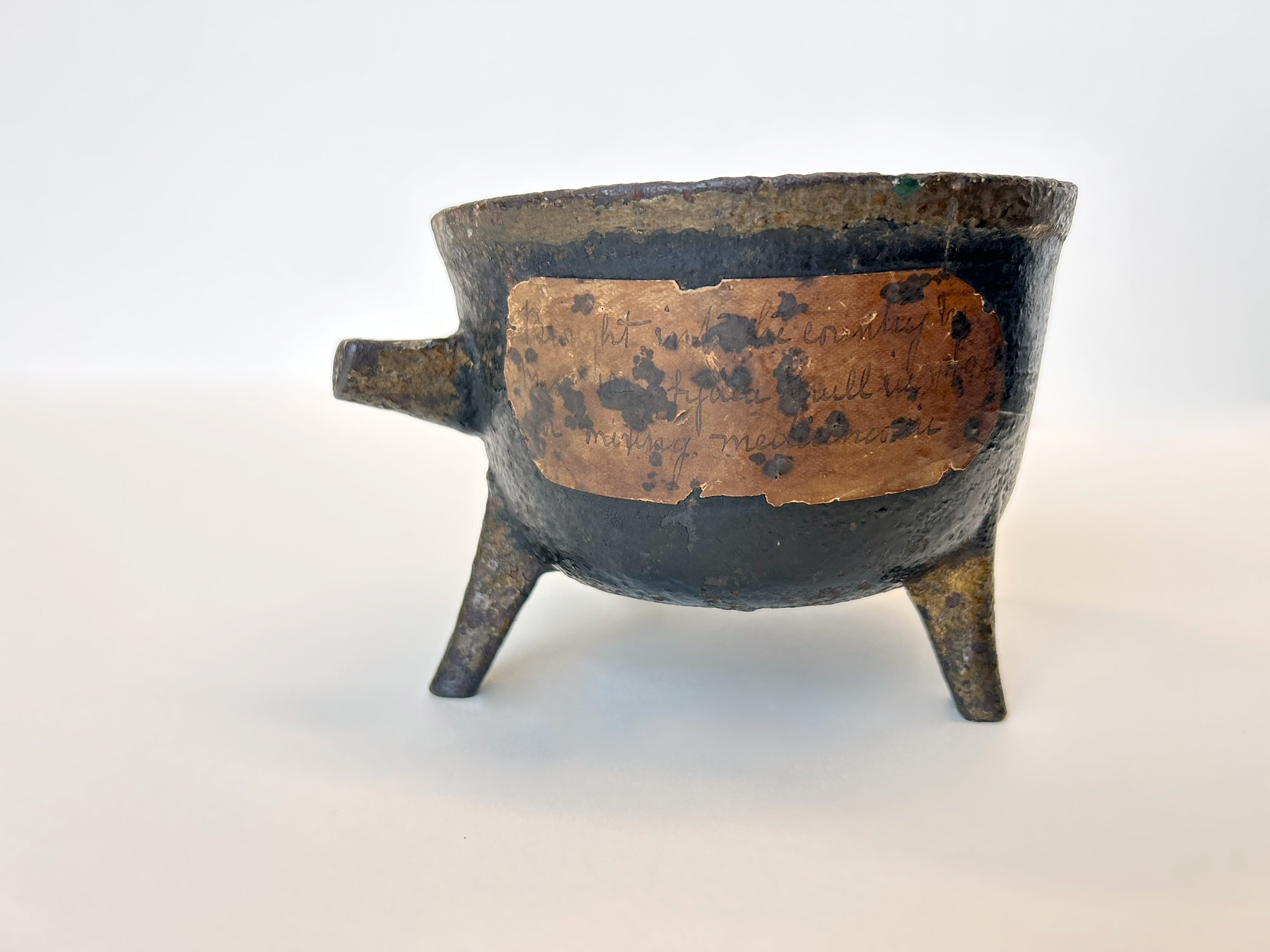
Collection Spotlight: The Trull Pot is an artifact in CLMA’s collection that once belonged to Lydia Trull. Lydia and her husband John arrived in the Courtice area in 1794. As a daughter of a doctor, Lydia helped her community with her knowledge of medicine. She was widely renown for her skill and people traveled great distances to be treated by “Dr. Lydia.” She used this pot for compounding, or mixing, medicinal ingredients.
Collecting Courtice
In the CLMA’s collection we have original artwork by artist Emily Stanisz depicting some of the heritage homes that are no longer standing.
As part of our Celebrate Courtice History events, CLMA is looking to source archival materials relating to the history of individuals, families, businesses, and organizations from Courtice. Please visit our Celebrating Courtice History page for more information.